

Supply Chain Network Optimization
Purpose: Align supply chain networks to optimize service, inventory, and transportation costs
Supply chains evolve via organic growth, mergers and acquisitions, strategic alliances, new products and services, shifting demand, global economic shifts, and changes in sales channels. Companies find cost savings and improve service levels by periodically re-aligning network infrastructure in response to supply chain changes.
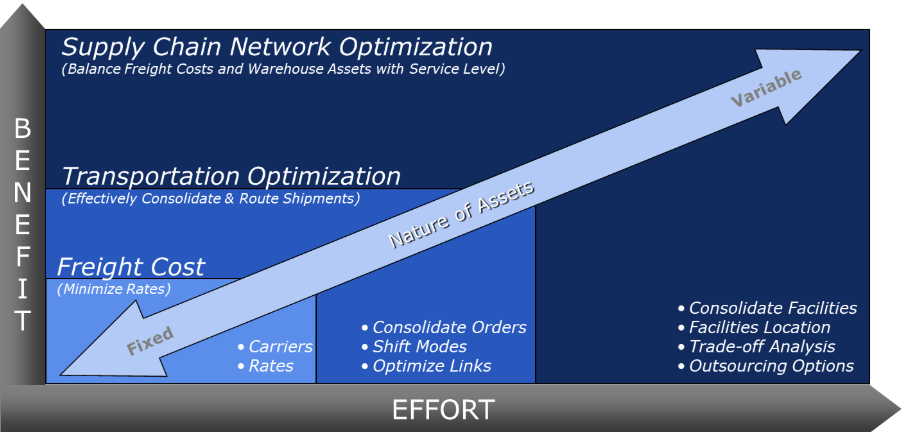
In the short-term, many assets are viewed as “fixed”, like existing warehouses and value-added facilities. In the long-term, the nature of assets is “variable”, such as when contracts end and they exceed useful life. Trade-off analysis helps to know when the cost of a fixed asset falls below the cost of changing it.
Approach: Model logistics data to determine optimal facilities locations and inventory levels
It is important to establish a performance and cost baseline. 3PLR evaluates facilities locations relative to suppliers, plants and customers, volumetric capacities, sales channels, service level requirements, and inventory deployment and velocity through the network.
3PLR uses proprietary software to model network scenarios and discover the optimal configuration and estimate costs and service benefits, followed by development of a high-level implementation roadmap.

Discovery: 3PLR starts by gaining an understanding of the client’s business model, products and value-added capabilities, growth strategy, historical development of the facilities network and inventory deployment, customer needs, key operational and financial metrics and targets, and key questions and goals for network optimization.
Data Collection: 3PLR collects extensive data to create a baseline model of the client’s current state supply chain logistics operations in terms of volumes, locations, costs, and performance. It is important to provide complete and accurate data, as well as to validate the current state.
Setup Decision Support System (DSS): 3PLR inputs data and constraints for modeling into DSS with an SQL data structure using standard routing and location algorithms and a user interface to input variables or constraints. Combinations of variables and constraints represent “what-if” scenarios to determine outcomes in terms of critical factors, such as operating costs, working capital, throughput capacity, and service levels.
Baseline Analysis: 3PLR conducts comprehensive analysis to develop a current state baseline and reviews findings with the client to validate them, ensuring a complete and accurate data set for modeling.
What-If Scenario Modeling: Scenarios are simply “what-if” questions to understand the impact of changing key variables and constraints on the overall supply chain cost efficiency and effectiveness. Variable changes may include:
- Adding or consolidating plants or warehouses.
- Location of one or more plants or warehouses.
- Impact on planned acquisitions.
- Growth rate for a product line or region.
- Product mix or volume provided by each plant or warehouse.
- Raw material sourcing changes.
- Sales channel expansion and new markets.
- Potential logistics outsourcing (3PL) options.
- Performance constraints, such as order and delivery lead-time.
Future State Design: The models provide clarity to expected outcomes based on initial scenarios, new “what-ifs” naturally follow until the process of qualification yields an optimal solution or best options based on certain trade-offs. These results propose a future state network with estimated impacts in terms of costs, assets, and service level.
Decision Support & Planning: Modeling is an iterative process that provides the client with opportunities to validate baseline data and analysis, identify initial “what-if” scenarios, review modeling results, change variables and re-run models until the right solutions are revealed. Our consultants support the decision process and roadmap planning to implement the optimized supply chain network and operations.
Deliverable: Network design options that minimize logistics costs based on service levels.
3PLR delivers analysis and modeling results that identify the optimal locations of key facilities relative to value-added activity centers, and supply and customer bases. Solution options presented incorporate transportation and warehousing cost impacts, inventory deployment changes, expected customer service levels, and implementation options. 3PLR facilitates management discussion to agree on the right path forward and delivers a high-level implementation roadmap.
Key Benefits:
- Optimal Number and Placement of DC’s and/or Warehouses
- Supplier to Plant and Warehouse Alignment
- DC to Customer Alignment for Improved Service Levels
- Optimal Inventory Levels to Decrease Inventory Carrying Costs
- Decreased Transportation Delivery Costs (TL, LTL, Parcel)
- Optimal Use of Modes and Carriers
Ready to optimize your strategy?
Contact 3PLR or schedule a call to discuss your company’s needs and find the right solution to optimize your operations.
Case Studies
Supply Chain Network Optimization | Case Study 1
A major HVAC company with growing market share in 4 business units was looking to reduce order shipment time (i.e., increase service level) and on-hand inventory through network optimization and consolidation of facilities serving 250 branches.
Supply Chain Network Optimization | Case Study 2
Optimize Inbound & Outbound Networks – A major motorcycle manufacturer wanted to identify cost saving opportunities and implementation strategies to streamline the distribution of both finished goods and after market parts through the dealer network.